

Somaly’s Journey to Agroecological Vegetable Farming
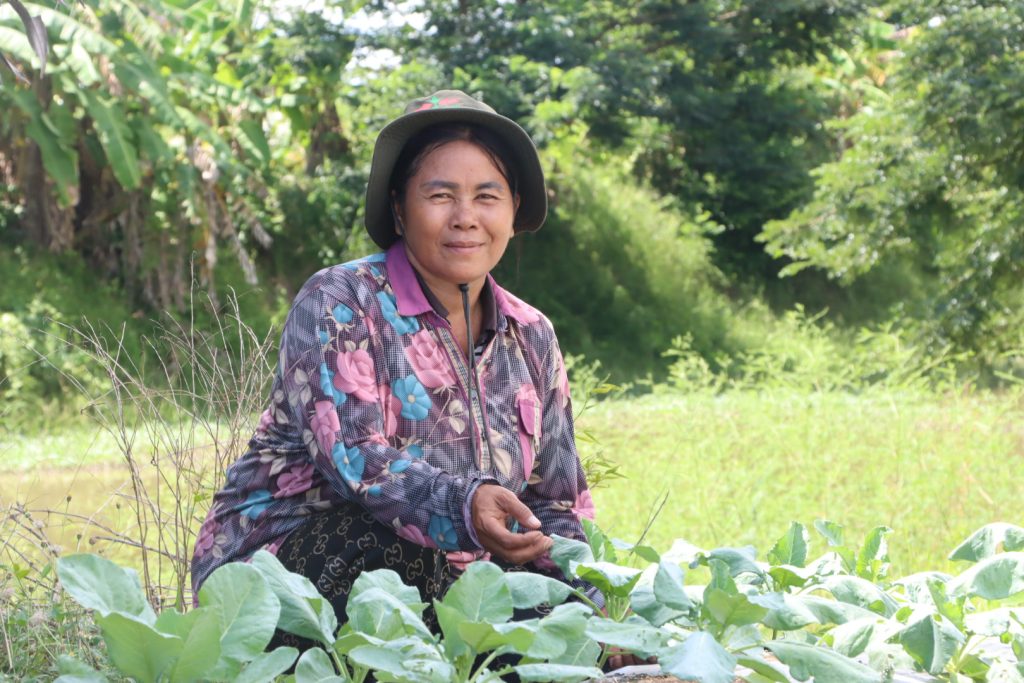
BANTEAY MEANCHEY PROVINCE, CAMBODIA – Orn Somaly wears two hats. The busy 52-year-old is both a vegetable grower, increasing her productivity through agroecological practices, and a vegetable collector, playing an important role in linking local farmers to markets.
Vegetable Farming as a Livelihood
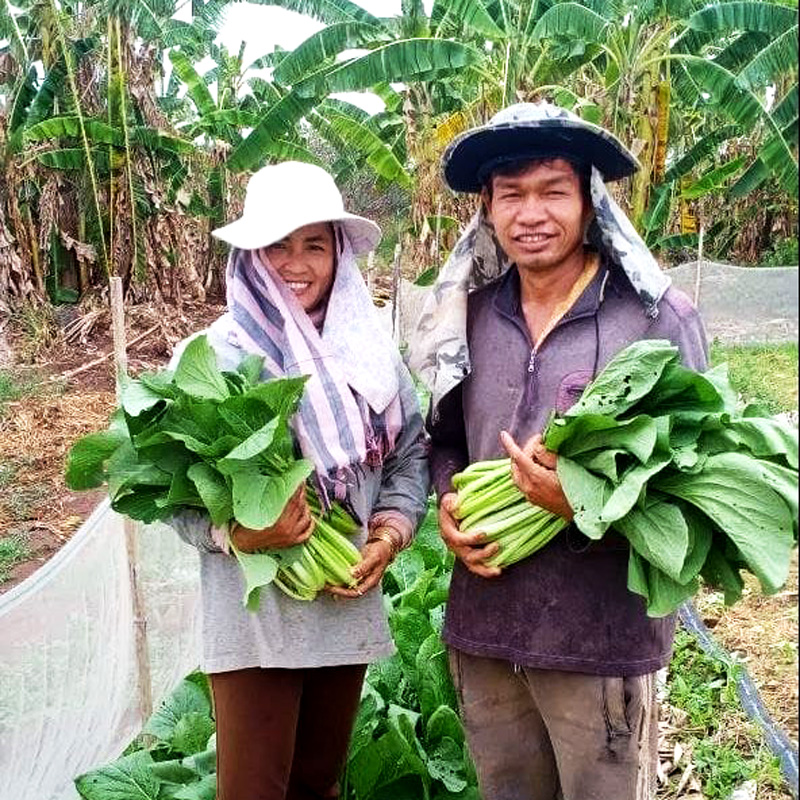
With her husband and three grown children, Somaly cultivates a range of vegetables, including bok choy (pak choi), yard long beans, cucumbers, and tomatoes, on a 3,200-square-meter farm in the village of Ka Svay, which is located in Rohat Tuek Commune, Mongkol Borey District. Vegetable farming is the family’s primary source of income, bringing in approximately 100,000 riels (US$25) per day.
The foundation for Somaly’s success was laid in April 2024, when she joined Phase 1 of the Nurture Veg project, which promotes agroecological vegetable production among smallholder farmers. The project is implemented by East-West Seed Knowledge Transfer (EWS-KT) with funding support from the Swiss Agency for Development and Cooperation (SDC), HEKS/EPER, and Caritas Switzerland. Through the project, farmers receive technical training, coaching, and agricultural inputs to establish demonstration plots that showcase improved vegetable production practices.
Seeing the Potential of Sustainable Techniques
Before participating in Nurture Veg, Somaly relied on traditional farming practices. After joining Phase 1 of the project, she participated in hands-on training sessions at another farmer’s demonstration plot. There, she began to learn new approaches to some of the problems she was facing, like water scarcity and pest infestations.
In May 2025, she became a key farmer under Phase 2 of Nurture Veg and started her own demonstration plot, using improved agricultural techniques to grow bok choy.
Her first demonstration plot was 400 square meters, and she invested 246,350 riels (US$61) in production costs. At harvest, she generated a net profit of 355,650 riels (US$89), representing a return on investment (ROI) of 144%.
For her second demonstration plot, she cultivated 300 square meters of bok choy and invested 253,500 riels (US$63) during the off-season. Off-season harvests often fetch higher prices in the market, and this demonstration plot generated a net profit of 796,500 riels (US$198), achieving an ROI of 314%.
Adopting Agroecological Approaches
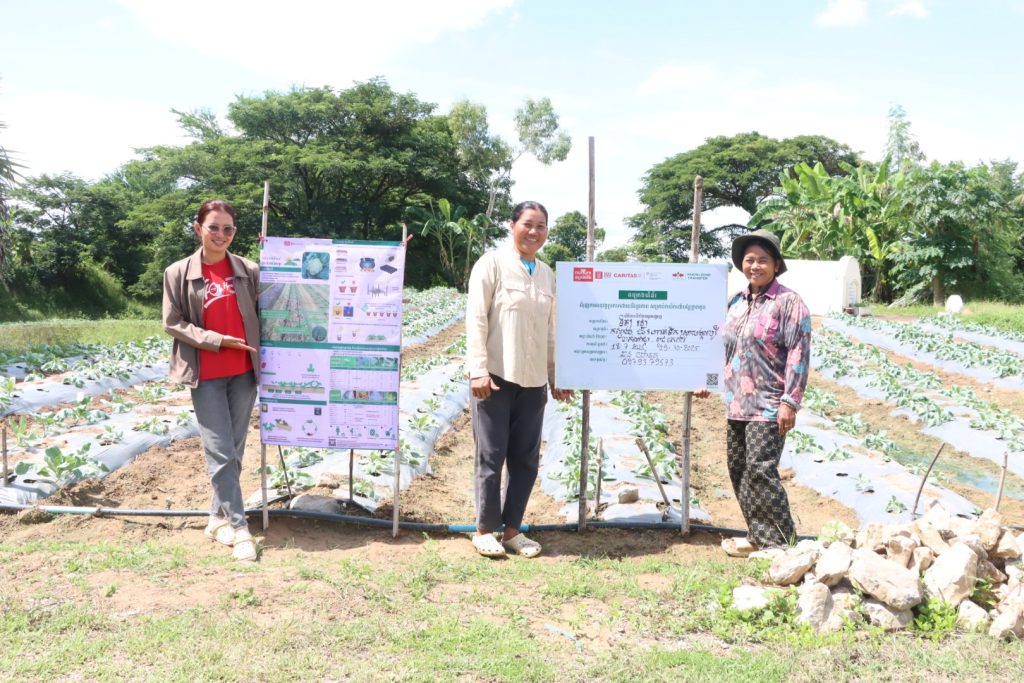
Somaly’s demonstration plots showed her the benefits of new methods—and a new mindset. Water shortages during the dry season, pest infestations during hot weather, and fluctuating market prices during peak production periods continue to present significant challenges for both fruiting and leafy vegetables on her farm. But now she has some solutions.
To adapt to water scarcity, Somaly diversifies her crops by growing herbs such as sweet basil, peppermint, peperomia, and sawtooth coriander. She also practices mixed cropping; for example, planting coriander alongside leafy vegetables to maximize land use and reduce production risks.
To address insect pests, one of the key practices she has adopted from the Nurture Veg training is the preparation and use of botanical pesticides. She makes her own biopesticides from locally available materials such as hot peppers, lemongrass, neem leaves, and neem bark. These ingredients are boiled, fermented, and stored for application when pest infestations occur. Using biopesticides as a first-line treatment reduces the use of inorganic pesticides, which Somaly reserves for intractable pest outbreaks.
“I prioritize natural pesticides because I want to produce healthy vegetables that are safe for consumers and not harmful to my own health. I also learned about proper pesticide management. Even when using biopesticides, I stop spraying at least two weeks before harvest to avoid any residues on vegetables. I also inform buyers about the harvesting schedule, and vegetables are not harvested during this withdrawal period.”
Since joining the project, Somaly has significantly expanded her production. Previously, she farmed during two growing seasons. Through training on crop rotation and mixed cropping systems, she now produces vegetables up to four times annually. This not only keeps income flowing at a consistent rate but helps to mitigate fluctuating market prices, as vegetables can be harvested outside of peak production periods.
“Before joining the project, I only grew vegetables twice a year. Now I practice crop rotation and mixed cropping, which allows me to produce vegetables four times a year. I also learned how to adjust bed height according to seasonal conditions and how to raise seedlings in net houses to protect them from insect damage before transplanting to the field.”
Linking Farmers to Markets
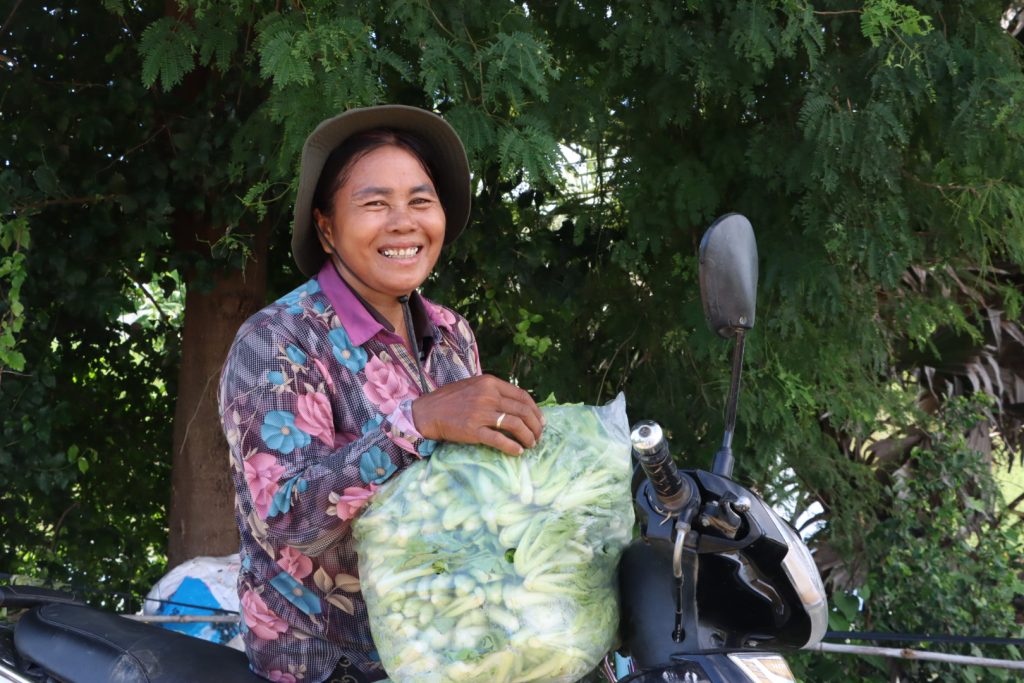
In addition to growing her own vegetables, Somaly purchases produce from farmers in her village and supplies it to larger traders who sell at Hung Heng Market in the province’s capital.
Depending on seasonal production levels, she collects between 200 and 500 kilograms of vegetables per day. She purchases both small and large quantities, mainly collecting cucumbers, yard long beans, hot peppers, spring onions, and leafy vegetables. She is generally able to sell all of the vegetables she collects, generating 20,000–60,000 riels (US$5–US$15) in extra income per day.
As an experienced collector, Somaly advises farmers to properly grade and classify their vegetables before sale. She explains that failure to separate leafy vegetables from fruiting vegetables can reduce market value by 300–500 riels (US$0.07–US$0.12) per kilogram. Simple but impactful advice like this from a trusted agricultural partner helps farmers get the most out of their harvest.
While the farmers she purchases from decide on their own which crops to grow, she regularly advises them to align production with market demand to improve profitability. The Nurture Veg project has further enhanced her collection skills through training on post-harvest handling, including packing and transportation.
Somaly is proud of what she has achieved through the Nurture Veg project, and she remains committed to cultivating vegetables using the agroecological practices she has learned. Looking ahead, she hopes to expand her cucumber production, which has previously experienced leaf curl symptoms and low yields. With EWS-KT’s guidance, she is determined to improve her skills and increase her cucumber harvest.