

Diversifying Through Commercial Vegetable Production: Koem Lang’s Story
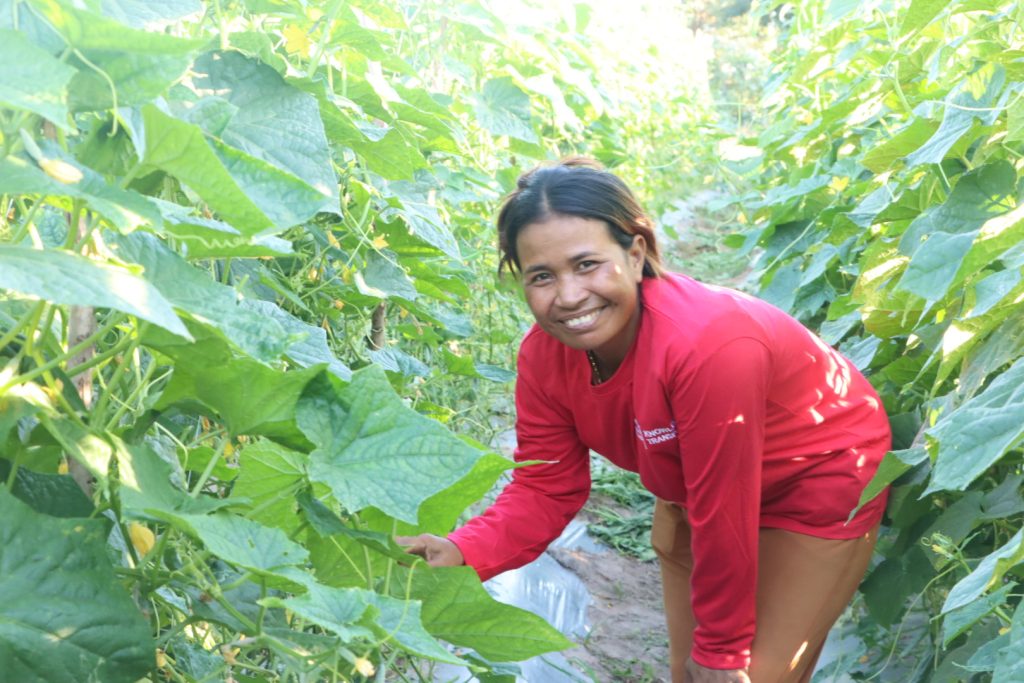
BATTAMBANG PROVINCE, CAMBODIA – Sot Koem Lang is a busy woman, growing corn, rice, and now vegetables on her farm in Prey Thralach village.
Beginning with Vegetables
For many years, Koem Lang relied mainly on corn and rice sales to help support her family. She grew only small amounts of vegetables, for household consumption. Her husband worked as a house builder and often traveled to different provinces for construction projects, leaving her to manage the farm on her own.
Her journey into commercial vegetable production began with a community meeting organized by East-West Seed Knowledge Transfer (EWS-KT) about learning improved vegetable production using sustainable, science-based techniques. Motivated to improve her family’s livelihood and earn income regularly throughout the year, Koem Lang joined Phase 2 of the Nurture Veg project in April 2025.
Nurture Veg promotes agroecological vegetable farming practices among smallholder farmers and is implemented by EWS-KT with co-funding from the Swiss Agency for Development and Cooperation (SDC), HEKS/EPER, and Caritas Switzerland.
Over the next season, Koem Lang received both theoretical and hands-on training, learning land preparation, soil substrate preparation, nursery management, mulching, plant nutrition, pest and disease management, and water management, including drip irrigation.
Challenges & Good Results
Koem Lang’s path to commercial vegetable production was not always easy. During her first attempt at land preparation, she had trouble forming the raised planting beds. Planting her seedlings the right distance apart was also a challenge. However, with regular field visits from the EWS-KT technical team, she had the support she needed to persevere.
“I had never done this before,” she explained. “I tried to apply what I learned from the training, but I made mistakes. The technical team came to my farm and helped me prepare the beds properly for cucumbers. I was very happy, and the first results were good.”
In her first demonstration plot with EWS-KT, Koem Lang cultivated cucumbers on 300 square meters of land. The results were highly encouraging: with costs of 269,700 riels (US$67), she earned a net profit of 930,300 riels (US$232), achieving a 345% return on investment.
During her first season, she also grew yard long beans. When harvest time came, vegetable collectors visited her farm to purchase the produce. She also sold some vegetables at the wholesale market or directly to other villagers.
Growing Vegetables for the Market
Encouraged by strong market demand and good profits, Koem Lang expanded her vegetable production to include yard long beans, pumpkins, and additional cucumber plots. She shared, “I decided to expand because vegetable farming gives me daily income. First, I expanded to 500 square meters of cucumbers, then added another 4,000 square meters.”
With continuous guidance and hands-on support, Koem Lang has gained confidence as a commercial vegetable grower, using part of her vegetable proceeds to purchase an irrigation pump for her fields.
Seeing the positive results, her husband decided to stop traveling for construction work and instead support her on the farm. Together, their activities now include vegetable cultivation alongside corn, rice, and cattle raising.
Koem Lang expressed that she never imagined she could grow vegetables on such a scale. In addition to providing a more regular income stream, vegetable production has diversified the family’s farm, reducing their financial risk and strengthening resilience.
The knowledge Koem Lang gained through the Nurture Veg project has significantly improved her family’s income and quality of life. Today, her earnings help support her children’s education, cover daily and social expenses, purchase agricultural inputs, and allow her to save for future investments.