

Working with the Seasons and Soil in Bangladesh: Monira’s Story
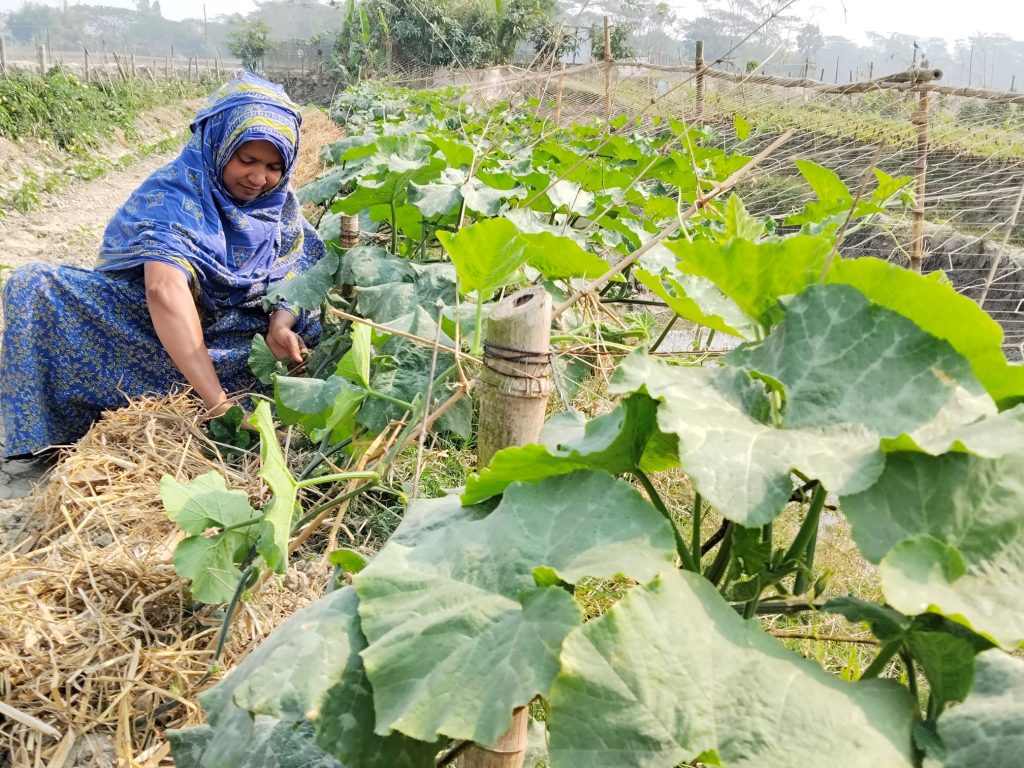
BARISAL DIVISION, BANGLADESH – Monira Begum, a 42-year-old farmer in the Galachipa upazila of Patuakhali district, is regarded as an exemplary and dedicated farmer by both her community and the local agricultural officer. But her passion for farming faced a harsh reality during the 2024 monsoon season, when her bottle gourd crop failed completely.
Identifying and Addressing Knowledge Gaps
Shortly thereafter, an East-West Seed Knowledge Transfer Foundation (EWS-KT) Technical Field Officer and local agriculture officials visited Monira’s farm and identified some practices that contributed to her crop loss—flat planting beds that left her plants vulnerable to waterlogging, a lack of mulching that led to soil erosion and degradation, and fragile trellises that could not withstand heavy rains.
Worried about possible future losses, Monira was eager to learn new farming methods. The next season, in 2025, she started a 500-square-meter pumpkin demonstration plot with EWS-KT. The Technical Field Officer worked with her to not only fix the identified gaps but improve the rest of her farming practices.
Demonstration plots serve as learning sites for the community, and the Technical Field Officer conducted four training sessions at Monira’s pumpkin plot, covering land preparation, seedling production, transplanting, high trellis setup, fertilizer application, responsible pest management, and post-harvest handling of vegetables.
Through the trainings, Monira learned many climate-smart techniques that were uncommon in her area, including raised beds, mulching, and protected seedling production.
“Learning these techniques changed my life,” she said. “I no longer fear the seasons; I work with them.”
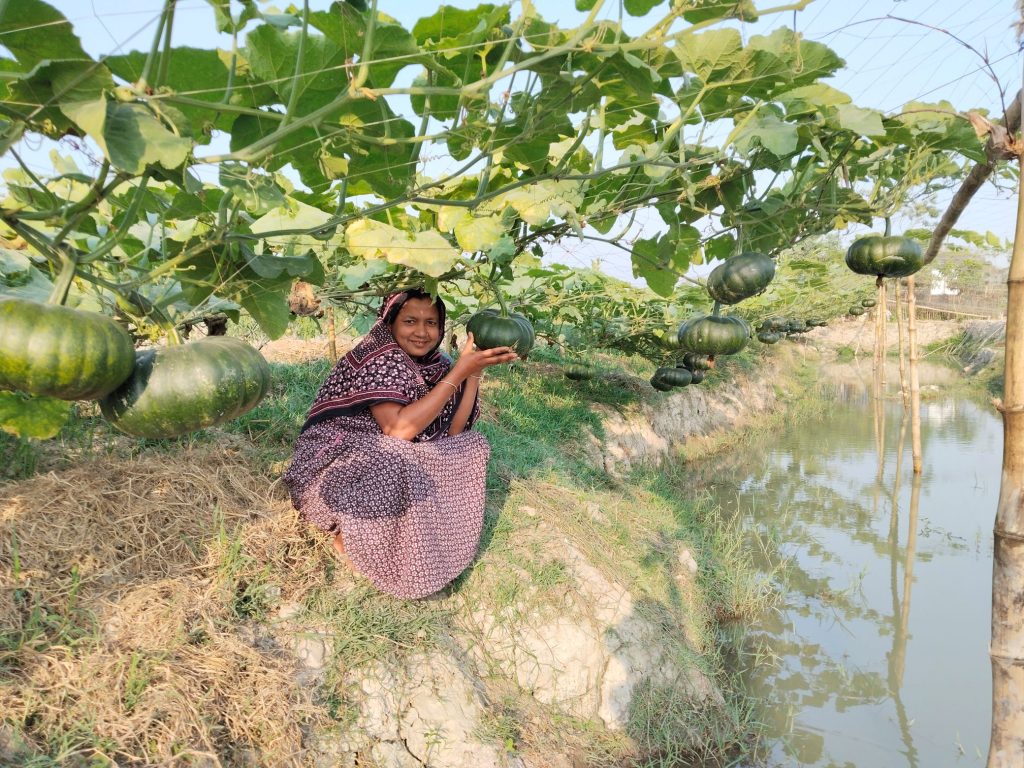
The pumpkin demonstration was a resounding success. From an initial investment of 5,800 taka (US$47), Monira earned a net profit of 18,000 taka (US$147)—an impressive 310% return on investment. After seeing the impact of improved farming practices, she expanded her vegetable production area to 2,000 square meters.
A Vermicompost and Soil Health Champion
One technique that Monira was especially impressed with was vermicomposting—using worms to break down food scraps and decomposed cow dung into rich compost.
The use of vermicompost as a medium for seedling production altered her entire perspective on soil. Witnessing the vigorous growth of her seedlings, and later of her crops planted in vermicompost-enriched soil, she became a vocal community advocate for increasing organic matter in soil. She actively raises awareness about the use of vermicompost and the important role that organic matter plays in soil fertility, and she encourages neighboring farmers to move away from agronomic practices that gradually weaken soil health.
Monira also now makes her own vermicompost, producing about 120 kilograms every 2 months, year-round. She applies this rich soil amendment to her fields and estimates that this has reduced her nonorganic fertilizer use by at least 50%. She currently uses all the vermicompost she produces, but selling some of her vermicompost to other farmers could bring her additional income in the future.
In addition to educating her community about the elements of healthy soil, Monira remains an active learner, participating in farmer exchange visits and peer-learning sessions to continually sharpen her expertise.
Monira learned about climate-resilient vegetable farming practice under the Smart Farming, Healthy Food project (2020–2025), which was supported by the Netherlands Enterprise Agency (RVO) / Dutch Ministry of Foreign Affairs and implemented by EWS-KT in partnership with Solidaridad and the Bangladesh Department of Agricultural Extension.