

From Trader to Climate-Resilient Farmer: Daw Aye Aye Myaing’s Story
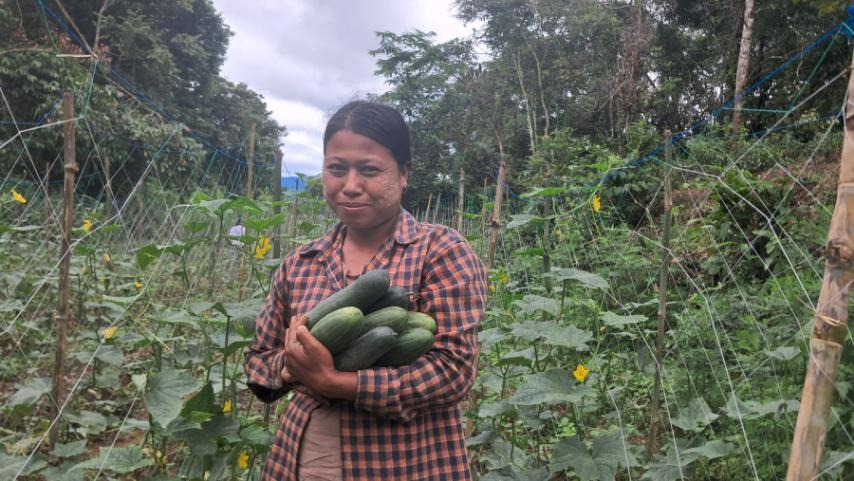
SHAN STATE, MYANMAR – Until last year, 38-year-old Daw Aye Aye Myaing earned her living as a collector and trader, buying and selling items like citrus fruit and tea. Although she also grew mustard and cauliflower, these vegetables were only for her family’s consumption.
In February 2025, inspired by one of her friends, she started on a new path. Her friend told her about the improved vegetable techniques she had learned from East-West Knowledge Transfer (EWS-KT) under the Foster Veg project and suggested that Daw Aye Aye Myaing grow vegetables for the market as well.
Daw Aye Aye Myaing visited her friend and observed the techniques applied in the field. Impressed with the results and the success of the farm, she decided to follow in her friend’s footsteps.
Seeking Help from the Experts
Wanting more guidance than what her friend could provide, Daw Aye Aye Myaing contacted EWS-KT to organize a training in her village. Years ago, she had tried unsuccessfully to grow cucumbers, and she was hopeful that EWS-KT staff could show her how to become a profitable cucumber farmer.
There was a lot to learn.
In the past, she had scattered cucumber seeds on the seed beds, then transplanted the seedlings to her field without any special land preparation. With EWS-KT, she learned how to grow strong seedlings to give her farm the best start. She had not thought before about what soil mixture would provide the right nutrients, or that sterilizing the soil with heat would protect the young sprouts from soil-borne diseases. For the first time, she was exposed to science-based techniques that could help her grow vegetables effectively.
She learned not only how to make the raised beds she had seen at her friend’s farm, but also why they were beneficial for the plants. Because the soil is less compacted, the plants develop a stronger root system. In addition, when too much rain arrives, the water drains more quickly and collects between the beds, rather than oversaturating the root zone.
Climate-Smart Techniques for Sustainable Income
Daw Aye Aye Myaing carefully followed the recommendations for plant spacing and fertilization, and she set up trellis nets to keep her valuable cucumber crop off the ground. At harvest time, she was rewarded with high-quality cucumbers that were the right size for the market, bringing a better price. From her 400-square-meter plot, she earned a net profit of 1,662,956 kyat (US$512) after costs of 467,706 kyat (US$144)—a 356% return on investment.
During the next season, she grew pumpkins, earning a net profit of 737,287 kyat (US$227) from similar expenses, and the profit from her crops covered the school fees for her children.
Since then, she has continued with her new livelihood, using the knowledge she gained to earn an income through vegetable production.
While she initially encountered challenges in finding workers to make the raised beds and in sourcing rice straw or other organic materials for mulch, Daw Aye Aye Myaing was happy to have both in place when she faced heavy rain during the most recent growing season. Due to these techniques, she was able to avoid waterlogging and crop damage. As climate change brings more erratic weather patterns to Myanmar, she is relieved to know farming practices that can mitigate these effects.
The Fostering Resilience Through Vegetables (Foster Veg) project (2023–2026) was supported by the Swiss Agency for Development and Cooperation (SDC) and HEKS/EPER. Focusing on southern Shan state, this initiative worked to improve the income and resilience of smallholder farmers through skills building and market development.