


Project Summary
Nurture Veg, Phase 1—Nurturing Sustainable Practices for Smallholder Vegetable Farmers
Cambodia | 2023–2025
Building on the success of this project, Phase 2 of Nurture Veg began on 1 April 2025.
Context and Project Objective
Rural farmers in northwestern Cambodia often struggle with low yields and poor-quality produce, and their challenges are now exacerbated by the effects of climate change. Many farmers also lack the planning and business skills to take full advantage of market opportunities. This limits their ability to earn a good income and results in an inadequate supply of vegetables available to lower-income consumers in the region, with associated impacts on community health.
Under the Cambodia Horticulture Advancing Income and Nutrition (CHAIN) project (2018–2021), EWS-KT worked to tackle market system constraints and improve service delivery to smallholder farmers, especially women-headed households. CHAIN encouraged smallholder farmers to diversify their production of vegetables by introducing advanced horticultural techniques and establishing the market linkages required to generate additional income, while addressing malnutrition by promoting dietary diversity.
Nurture Veg—Nurturing Sustainable Practices for Smallholder Vegetable Farmers is one component of the Nurture Project (2023–2026) being implemented by HEKS/EPER and Caritas Switzerland. Nurture Veg builds on the CHAIN project by:
- Focusing on the vegetable sector to build smallholder farmers’ climate resilience through strengthening income from vegetable production and diversifying livelihoods.
- Setting key indicators for women’s participation. EWS-KT is now better positioned to monitor impact through data collection that is disaggregated by gender; to learn lessons from gender budgeting and gender-specific approaches to recruit female lead farmers; and to increase women and youth participation through digital learning, online platforms, and mobile-based discussion groups.
- Building on the geographic areas reached during CHAIN, starting with Battambang and Banteay Meanchey; scaling to Preah Vihear and Oddar Meanchey in later phases to include more rural vegetable producers.
- Leveraging established partnerships with government departments, NGOs, and farmer groups to deliver improved gender-responsive horticulture extension and group-strengthening services.
- Catalyzing market development and inclusive business relationships between agricultural input dealers, equipment suppliers, technology suppliers, traders and buyers, and farmer groups.
The aim of this pilot project is to catalyze opportunity in less developed areas where farmers vulnerable to climate change struggle with low and poor-quality yields and have fewer income-generating opportunities. By creating opportunities for income development and greater resilience to climate change at the farm level, EWS-KT’s work will spur marketplace development and increase the supply of affordable vegetables for lower-income consumers. With improved knowledge, farmers can better optimize production toward specific market needs.
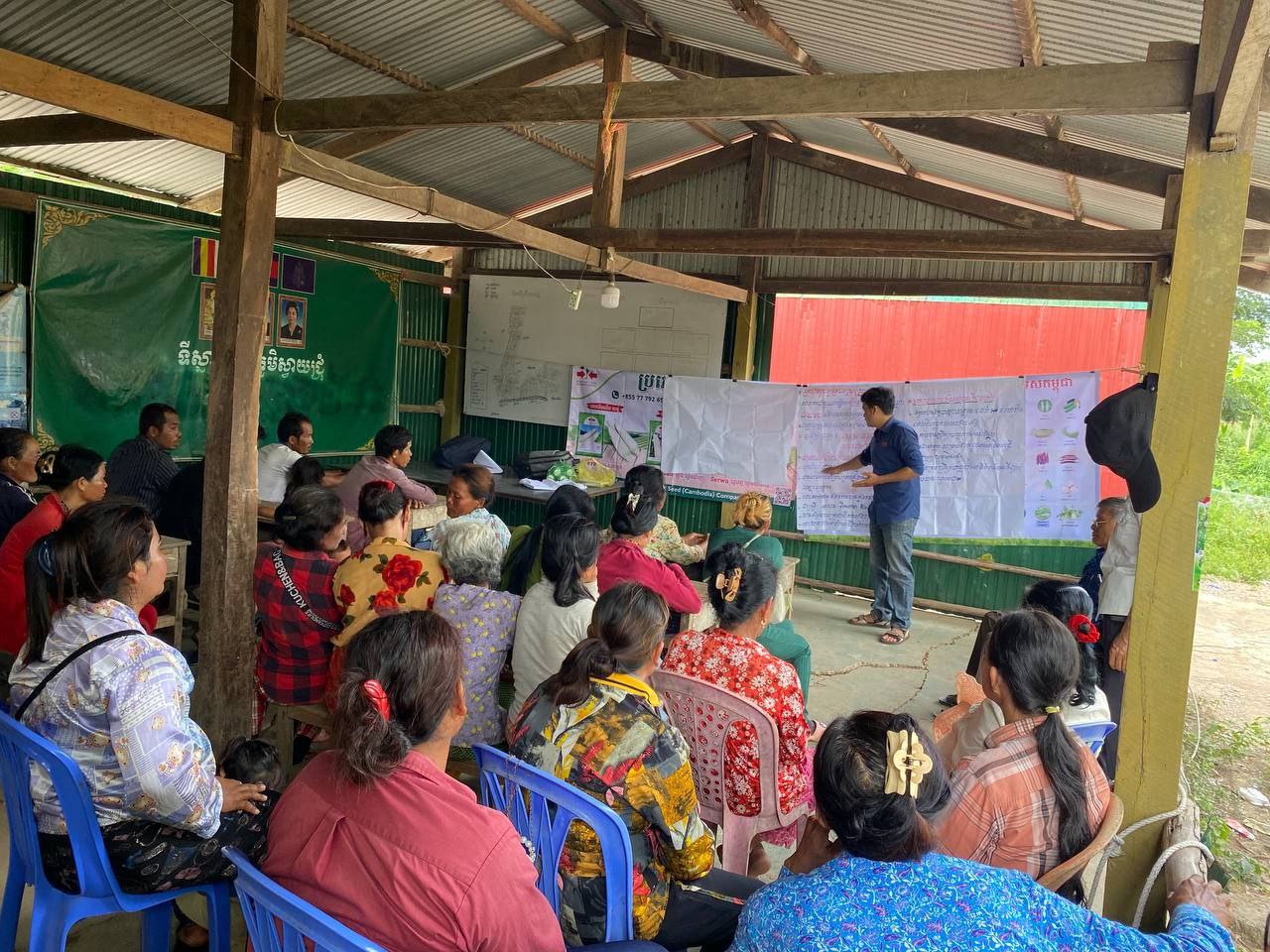
The project trains farmers by demonstrating vegetable farming techniques suitable for local agronomic and climatic conditions. Dedicated EWS-KT field staff teach modules on a wide range of topics, including these agroecological and climate-resilient approaches:
- Basic agronomy, soil improvement, and land preparation
- Seedling production (including grafting), transplanting, protective cultivation, and mulching
- Integrated pest management (IPM), including responsible use of pesticides
- Nutrient management
- Crop maintenance, harvesting, and production planning
- Water management and efficiency, including irrigation techniques
- Business and financial skills (variety selection, crop planning, record keeping, asset management)
Outputs & Outcomes Achieved
- Farmers Trained:
- 109 key farmers (52% women; 24% youth) established 324 demonstration plots to showcase innovative techniques for growing vegetables, with the demo plots also serving as training hubs. Key farmers were intensively trained over 2–3 crop cycles, with follow-up support from the EWS-KT team.
- 338 core group farmers (neighboring farmers recruited by the key farmers) were trained by the EWS-KT team at the demo plots and then supported by key farmers.
- 3,427 farmers attended regular field-based training events.
- 5,324 farmers were exposed to enhanced agroecological and climate-resilient techniques through existing EWS-KT and collector networks.
- In all, 65% of directly trained farmers were women, and despite recognized challenges in engaging young people in agriculture, 15% were youth.
- Agro-Input Dealers Trained: 65 agro-input dealers were equipped with the knowledge and skills to share improved technical information with their customers and promote climate-resilient agricultural practices.
- Market Linkages: 12 vegetable buyers were connected to smallholder farmers, providing farmers with better market access and higher prices for their produce.
- Access to Advice and Inputs: 34,307 farmers gained improved access to better advice, along with better-quality inputs, through existing EWS-KT networks, agro-input dealers, crop guides, and digital platforms.
- Adoption of Improved Techniques: 62% of farmers adopted at least 3 of the improved techniques recommended through the project.
- Increased Vegetable Yields: Farmers reporting improved yields experienced an average 65% increase in yield compared to baseline.
- Improved Incomes: Farmers experienced an average 36% increase in income from vegetable production.
- Environmental Contributions: The project promoted climate-resilient agricultural practices and agroecology techniques, such as organic fertilization, drip irrigation, biopesticides, cover crops, and crop diversification, to reduce environmental impact and increase productivity. Techniques like intercropping and soil conservation helped enhance biodiversity and preserve natural resources, contributing to long-term environmental sustainability.
EWS-KT Partners
Funding partners: Swiss Agency for Development and Cooperation (SDC), HEKS/EPER, and Caritas Switzerland
Project Period
1 August 2023 – 31 January 2025
Location
Cambodia: Battambang and Banteay Meanchey provinces