


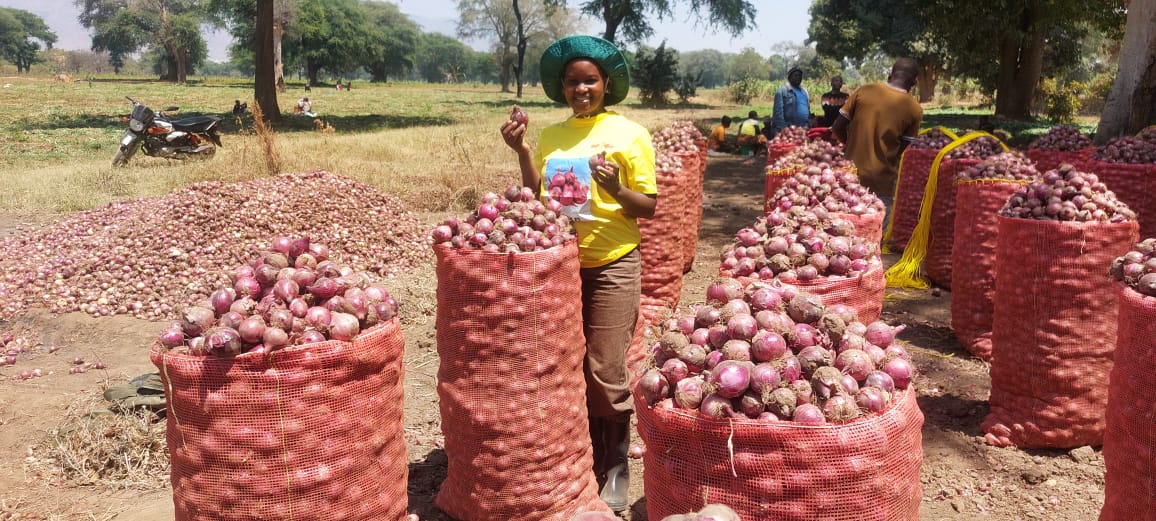
Promoting Sustainable Farming Practices to Accelerate Adoption of Agriculture Innovation in the Horticulture Value Chain
Context and Project Objective
Horticulture is a major component of Tanzania’s agricultural sector, contributing significantly to food security, nutrition, and economic development. While the demand for fruits and vegetables is growing both domestically and internationally, a weak national seed system and insufficient knowledge of sustainable and efficient farming practices hamper the sector’s ability to meet its full potential. In addition, the limited participation of youth and women in agriculture constrains the growth needed to meet increased demand.
Potatoes, onions, tomatoes, bananas, and avocados are important foods in Tanzania, where they serve as key sources of nutrition and income for many families. However, production of these crops faces critical challenges, including limited availability and accessibility of high-quality, market-aligned seeds and seedlings. In addition, inadequate access to extension services results in low awareness and adoption of yield-enhancing technologies and limited knowledge and use of context- and crop-specific sustainable farming practices, soil health interventions such as blended fertilizers, regenerative agriculture practices, water management, pest and disease management, and post-harvest loss management.
Implemented by a consortium consisting of EWS-KT (lead partner), Avocado Society of Tanzania (ASTA), Crop Bioscience Solutions, Farm For the Future Tanzania Ltd (FFF), and Maua Mazuri, the project aims to establish a sustainable, high-quality seedling supply chain system for avocados, potatoes, onions, tomatoes, and bananas and to advance farmer adoption of climate-resilient and sustainable farming practices, with a focus on the participation of women and youth. Within this framework, EWS-KT will concentrate on the vegetable value chain, with an initial emphasis on onion and tomato production. Maua Mazuri and Crop Bioscience Solutions will concentrate on the value chain for bananas, FFF on potatoes, and ASTA on avocados.
The project’s comprehensive strategy includes increasing the availability of quality seeds and seedlings; strengthening extension services, primarily through village-based advisors; improving access to digitalized context-specific extension content, climate information, and services; enhancing access to markets; and advancing climate-resilient and sustainable farming practices.
Through these activities, the project aims to reduce pest and disease prevalence, enhance product consistency to meet market demands, and ultimately open access to higher-value markets for young smallholder farmers.
Target Outputs
- 30,000 farmers (6,000 for each consortium partner) reached with knowledge and skills on climate-smart and sustainable farming practices through different extension events
- 300 village-based advisors recruited and mentored through training of trainers to provide fellow farmers with climate-smart and nutrition-sensitive agricultural advisory services and business management
- 15,000 farmers and other value chain actors involved in short-term or long-term training and mentorship
- 200 nursery operators, 50 extension workers, and 20 community development workers trained to produce quality seedlings
- 8 new nurseries established
- 5,000 youth engaged in work opportunities created by the project
- 10 training modules developed for agro-dealers, nursery operators, extension service providers, and village-based advisors
- 5 “center of excellence” learning farms established (1 for each partner)
- 8,300 farmers and other value chain actors participating in AGRA-supported extension services events
Partners
Funding partner: AGRA. An African-led organization, AGRA aims to catalyze a food system-inspired inclusive agricultural transformation across Africa to reduce hunger, improve nutrition, and adapt to climate change. AGRA advances uniquely African solutions to sustainably raise farmers’ productivity and connect them to a growing marketplace. Together with its partners—including researchers, donors, African governments, the private sector, and civil society—AGRA seeks to create an environment where Africa sustainably feeds itself.
Consortium partners: East-West Seed Knowledge Transfer (lead partner), Avocado Society of Tanzania (ASTA), Crop Bioscience Solutions, Farm For the Future Tanzania Ltd (FFF), and Maua Mazuri
Implementing partner: Tanzania Agricultural Research Institute (TARI)
Project Period
14 April 2025 – 14 March 2027
Location
Tanzania: Southern Highlands, Northern Highlands, and Western Highlands, with EWS-KT working in Iringa, Mbeya, Morogoro, and Njombe