



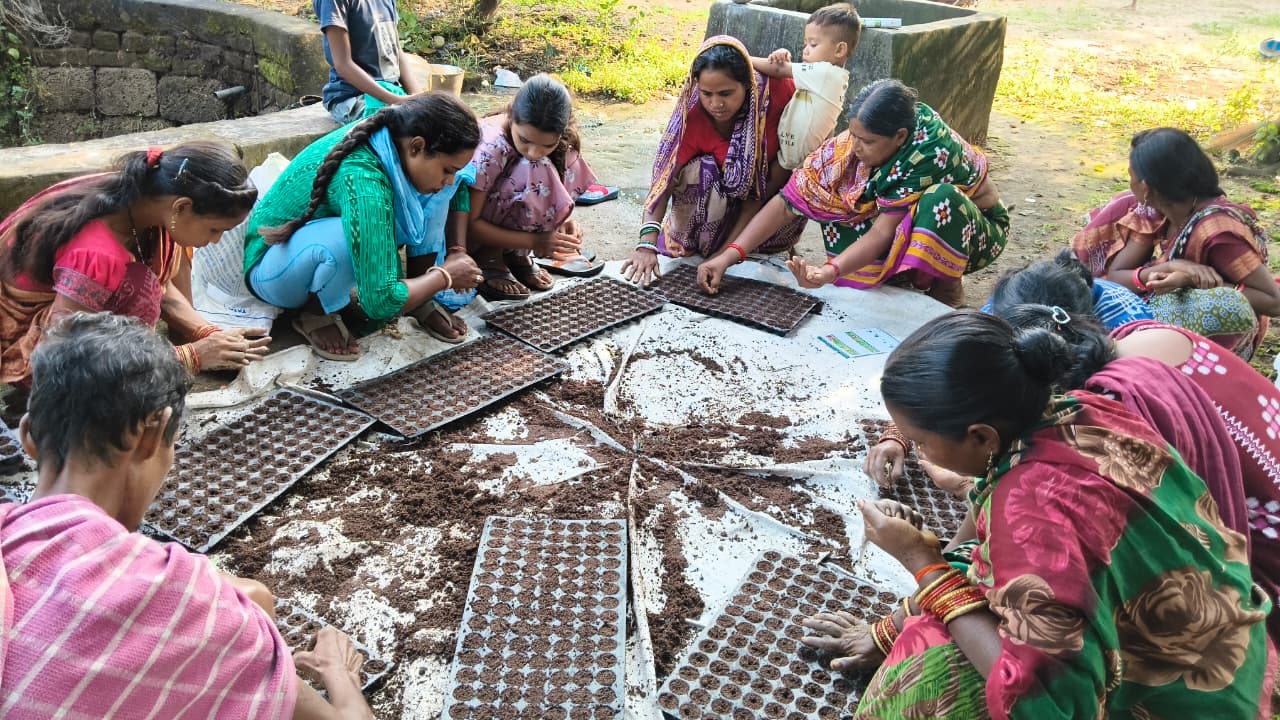
Enhancing Farmers’ Incomes Through Promotion of Sustainable Vegetable Production Practices
Context and Project Objective
In the Jharsuguda district of Odisha state, many villages are economically underdeveloped but have high potential for vegetable market development. Most farmers in Jharsuguda grow rice, and small landholdings restrict their ability to scale production and earn a better living. Those who already grow vegetables experience low yields, due in large part to limited knowledge of climate-resilient farming practices such as soil enrichment methods, efficient water use, and pest and disease management techniques. Farmers’ focus on rice also makes them more vulnerable to climate-related challenges and market instability. Diversification into vegetable production therefore offers opportunities for higher and more dependable income without increasing farm size.
With a goal to enhance smallholder farmers’ resilience, incomes, and livelihoods, this 6-month pilot project will build the capacity of 1,000 farmers—500 directly and 500 indirectly—in Jharsuguda by providing quality agricultural education and training in vegetable production over 2 cropping seasons.
Activities
The project’s multipronged approach blends sustainable vegetable production practices with market development components for deeper impact, and EWS-KT will utilize both in-person training and digital learning platforms for greater reach.
Reaching farmers through hands-on and digital modalities:
- On-farm demonstration plots: Establish 10 demonstration plots (300–500 square meters each) managed by 10 key farmers to showcase climate-smart and profitable vegetable growing techniques.
- Intensive farmer training: Using the demonstration plots as hubs, hold 60 training sessions on climate-resilient vegetable production. EWS-KT’s training modules cover agronomy, integrated pest management (IPM), climate-smart practices, and business planning.
- Field Days: During harvest, organize 7 public Field Days at the demonstration plots to illustrate the return on investment (ROI) from enhanced horticultural practices.
- Digital empowerment: Leverage digital platforms such as Instagram, WhatsApp, Facebook, YouTube, and EWS-KT’s GrowHow website to provide an additional 500 farmers with vegetable production information and resources.
Market development and sustainable knowledge transfer:
- Market linkage: Conduct weekly market surveys to gather up-to-date price data, giving farmers essential market insights. This data will also help farmers to select vegetable crops and varieties based on local market requirements, strengthening their business plans and increasing market integration.
- Community farmer facilitators: Identify and prepare two young Rural Education Workers (community farmer trainers) to train farmers and provide regular monitoring and guidance for one crop season during the project. These Rural Education Workers will be equipped with the knowledge and skills to continue guiding farmers into the future.
This project is part of Phase 1 of Epsilon Foundation’s Project Agri-Empower under its CSR program, and Epsilon employees will directly engage with the project’s work through a volunteer activity.
Expected Outputs & Outcomes
- Directly train 500 smallholder farmers (10 key farmers, 100 core group farmers, and 390 additional farmers). Of these, 67% are expected to adopt at least 5 climate-smart vegetable production techniques, leading to an anticipated doubling of yields.
- Provide vegetable cultivation information and resources to 500 smallholder farmers through social media channels and digital learning platforms.
EWS-KT Partners
Funding partner: Epsilon Foundation, the CSR arm of Epsilon Carbon Private Limited
Project Period
1 October 2025 – 31 March 2026
Location
India: Odisha state (Jharsuguda district)
