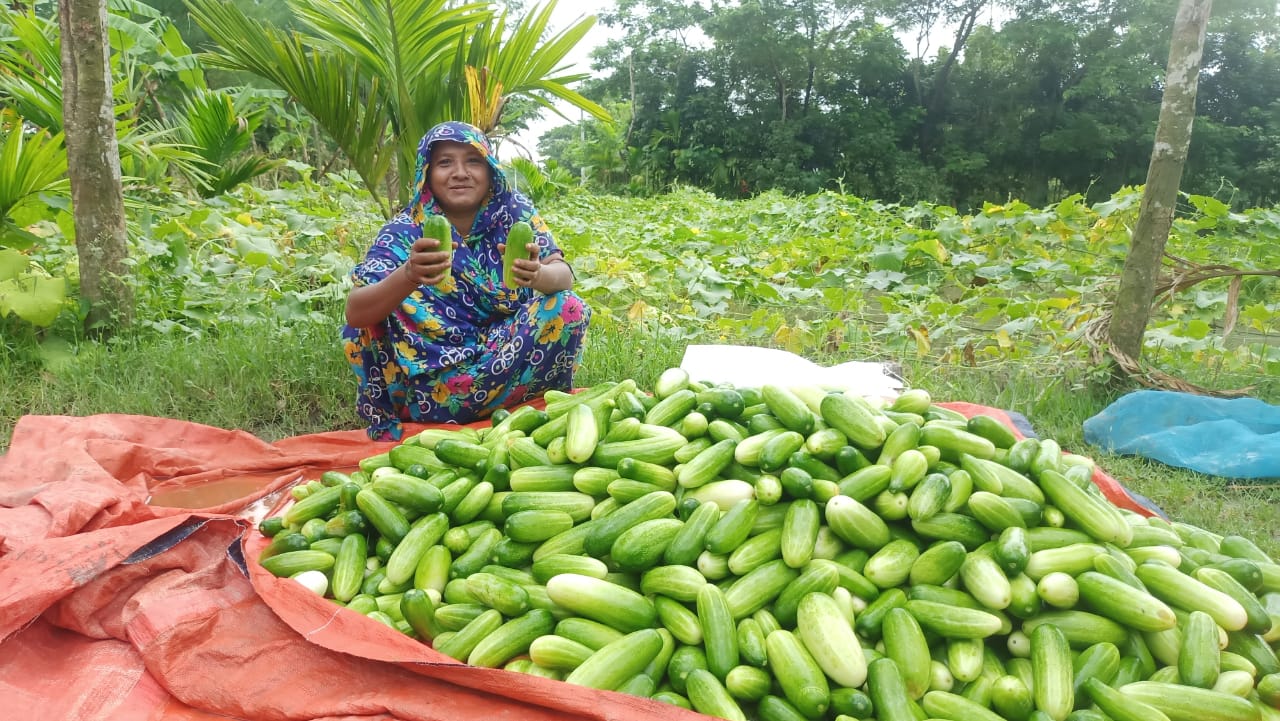


Cultivating Confidence: Khanindra’s Leap Toward Sustainable Farming
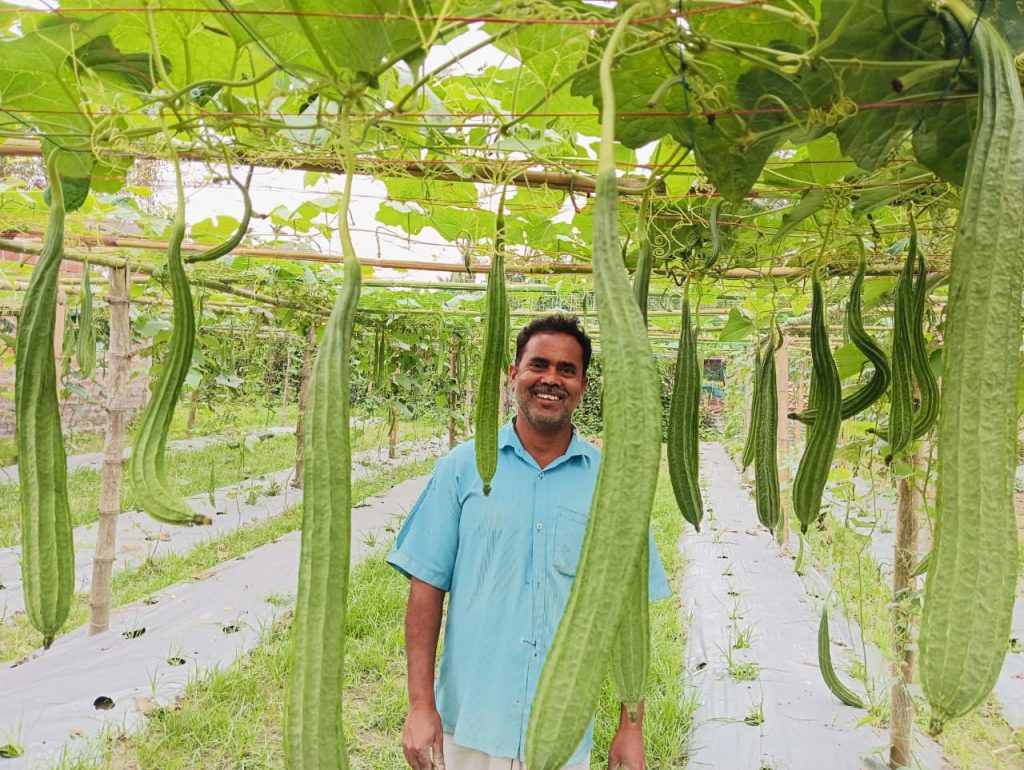
ASSAM STATE, INDIA – At Bauhi village in Kamrup district, 43-year-old farmer Khanindra Das walks with an unmistakable sense of assurance. His eyes trace the neatly mulched rows of ridge gourd vines climbing over bamboo trellises—a field that now stands as both a demonstration of modern technique and a testament to renewed faith in farming.
For years, Khanindra cultivated rice and seasonal vegetables like cucumber, ridge gourd, and bottle gourd on his 4-acre farm, following age-old practices passed down through generations. His results were modest, bringing unpredictable yields. With costs rising and more frequent rain and flooding leading to increased crop viruses, he felt a growing sense of frustration.
“Farming was getting tougher every year,” he admitted. “We worked hard, but the returns were not keeping up.”
Things began to change in January 2025, when he met Monowar Hussain, a Technical Field Advisor with East-West Seed Knowledge Transfer Foundation who was surveying nearby fields. “He spoke about improving productivity with simple, scientific methods,” Khanindra recalled. “I liked the idea and had heard about another vegetable demonstration field in Panitemai village. That gave me confidence to try.”
The Demonstration That Made the Difference
By July 2025, Monowar worked with Khanindra to establish a ridge gourd demonstration plot on his land as part of the Enhancing Smallholder Farmers’ Income and Livelihoods with Profitable Vegetable Production Practices in Assam project, co-funded by De Eik Foundation. The project introduced Khanindra to improved nursery management, raised beds, mulching, balanced fertilization, trellising, and integrated pest management—practices that reshaped the way he viewed farming.
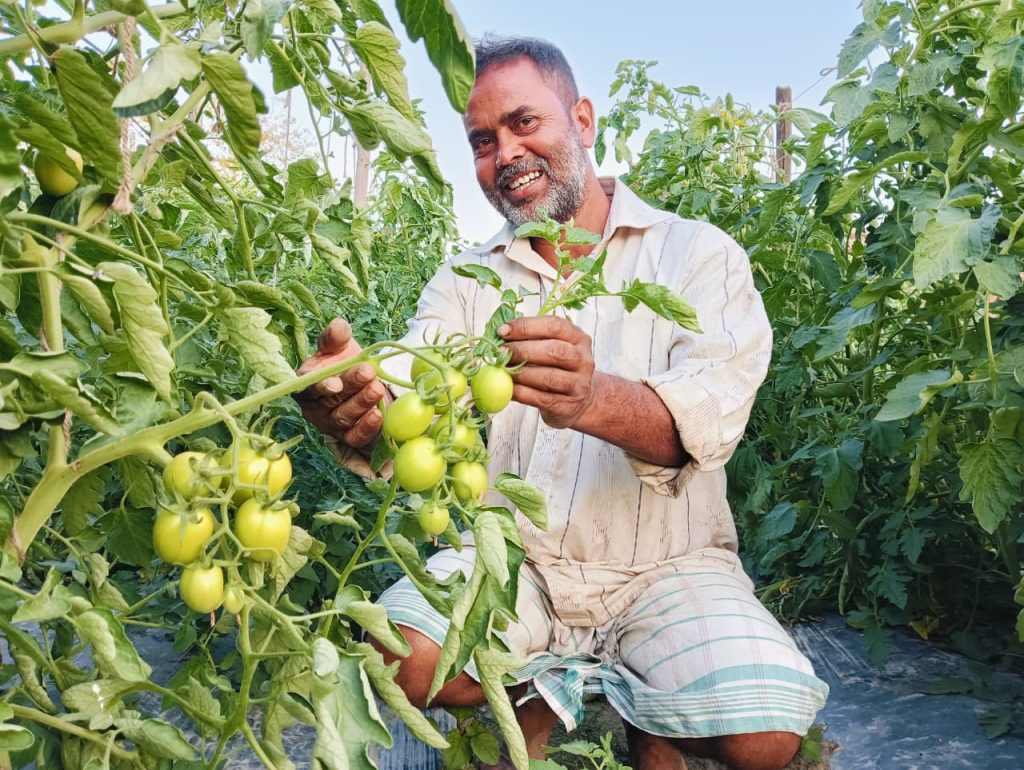
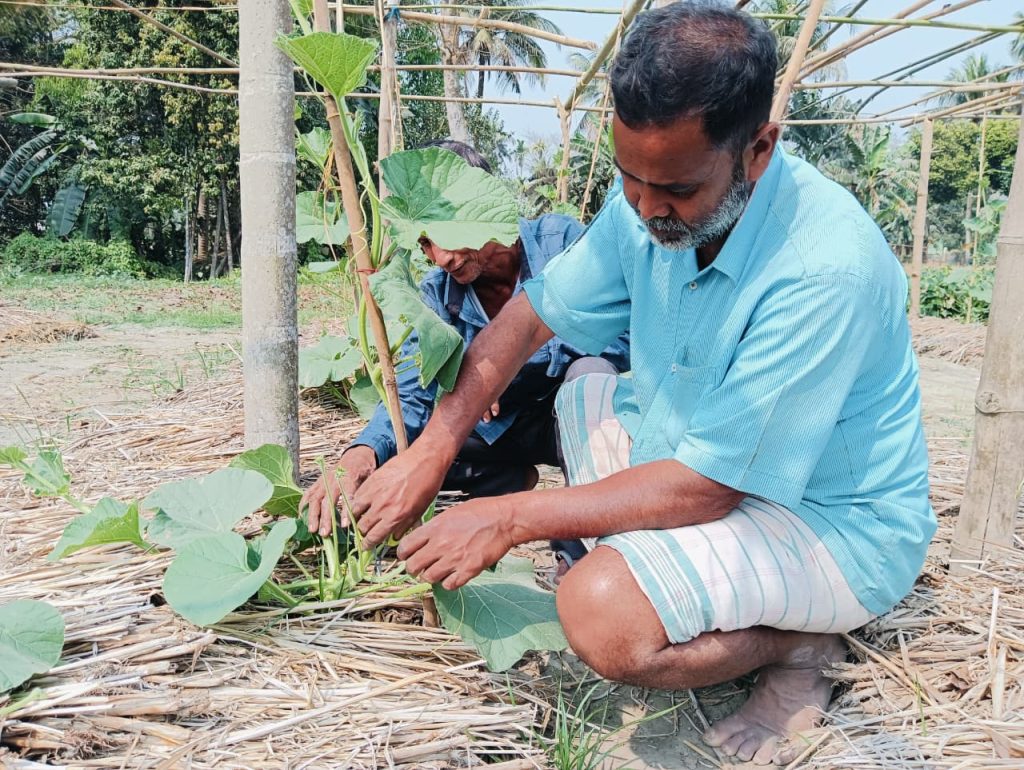
“It was a new experience,” he said. “Earlier, I planted directly on the field without spacing or nursery care. But now I could see how method and timing mattered.”
The transformation was visible within weeks. Seedling mortality dropped sharply, plants grew more uniformly, and irrigation was more efficient on the raised beds. The mulch not only suppressed weeds but also reduced the need for frequent watering—saving both time and money. “The best part,” Khanindra said, “was that my labor cost went down, yet my yield went up.”
As the vines began to flower and fruit, the once-skeptical farmers around him started visiting his plot. They were curious, intrigued, and eventually convinced. “They saw that I was not spending extra—just working smarter,” he said.
From Demonstration to Determination
Encouraged by the results, Khanindra decided to continue. He expanded the improved practices to two-thirds of an acre, adopting techniques such as mulching, trellising, plant spacing, nursery management, and balanced fertilization. Though he faced some challenges while trying new crops, he didn’t hesitate to seek advice from Monowar. “Whenever I got stuck, I called him. With his suggestions, I could manage the crop well.”
With growing confidence, Khanindra began to experiment, adapt, and lead.
A Farmer Who Inspires Others
Word spreads fast in villages, and so did Khanindra’s story. His demonstration plot became a local learning ground. “When farmers came to my field,” he said, “I showed them what I learned—sometimes I even demonstrated the techniques myself.”
For Khanindra, being seen as a model farmer brings quiet pride. “I never thought others would come to me for guidance,” he said. “Now, people recognize me more—they value my work.” His field has turned into more than a livelihood; it has become a symbol of progress in Bauhi.
A New Outlook on Farming
Khanindra’s journey of agricultural change also reflects a mindset shift. “Earlier, I used to depend on traditional ways,” he said. “Now I know that by using the right techniques, farming can be both easy and cost-effective.”
Currently, Khanindra is cultivating nine different vegetable crops across 1 acre of land, reflecting a strategic shift toward crop diversification and market responsiveness. His crop portfolio includes ridge gourd, bottle gourd, wax gourd, bitter gourd, yard long bean, tomato, hot pepper, eggplant, and pumpkin. This diversified vegetable production model strengthens his risk mitigation while optimizing his income.
From an agronomic standpoint, he is consistently applying several improved practices, including systematic land preparation, raised bed cultivation, trellising, use of improved seed varieties, and optimized fertilizer application protocols. He has also adopted a hybrid mulching approach, utilizing both plastic and organic mulch based on crop-specific requirements and seasonal conditions.
While Khanindra is demonstrating a high degree of technical assimilation and operational maturity in sustainable vegetable farming, his message to fellow farmers is simple: “These new techniques are not difficult—they are smart and cost-effective. Once you try them, you will never go back.”